What Responsible Finance Looks Like When Money Is Communal


Most financial products assume users make money decisions alone, but in Indonesia, money is communal. True fintech inclusion requires designing for shared family obligations, household dynamics, and long-term stability.
Key Insights
- The Individualist Flaw:Digital loans and apps treat users as sole decision-makers, ignoring that 67% of adults support multiple generations with shared income.
- Speed vs. Social Friction:While informal lenders and illegal apps succeed by matching real-life urgency, digital savings tools succeed when leveraging communal trust structures like Arisan.
- Redefining Fintech Success:Sector growth shouldn't just be measured by account openings or BNPL usage, but by whether households can maintain financial buffers against unexpected costs.
In many Indonesian households, the paycheck is already spent before it arrives. A portion goes to a parent's medication. Another covers a sibling's school fees. A relative's emergency takes what is left. By the time anyone opens a banking app, most of the decisions have already been made, often by several people across the household.
This is the reality most financial products in Indonesia are not designed for.
Money here travels through people before it settles anywhere. It moves through family expectations, obligation, and the real difficulty of saying no to someone you love. A 2022 Litbang Kompas survey found that 67% of respondents identify as part of the sandwich generation, supporting both their parents and their children. In our own research with 900 people across the country, Millennials told us they set aside IDR 1 to 2 million per month for each family member they support, before any personal savings are considered. Their income passes through the household before it settles anywhere, and the decisions around it are rarely made alone.
Most financial products are still designed around a single financial decision-maker, even when money at home rarely works that way.
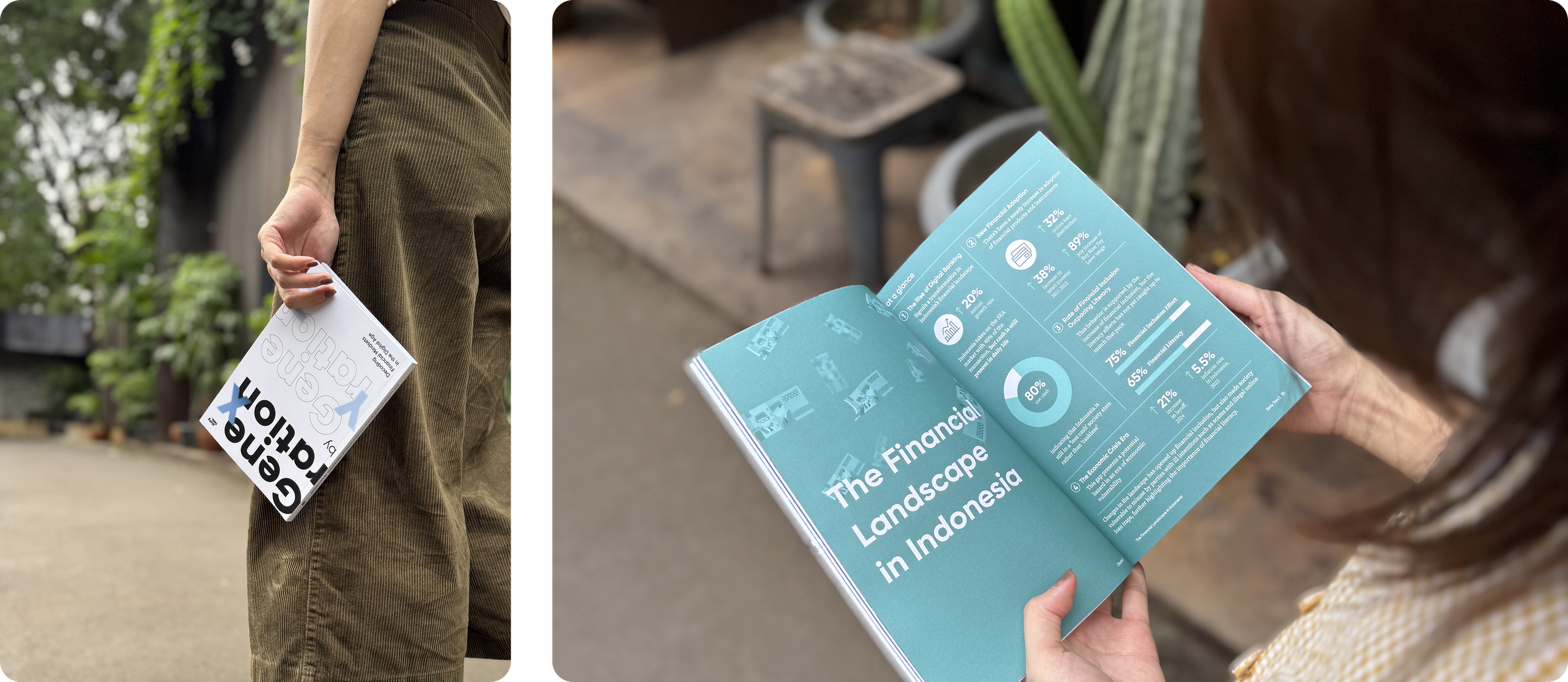
The 2024 National Survey on Financial Literacy and Inclusion from OJK and BPS reports that Indonesia's financial inclusion index sits at 75%, while financial literacy is at 65%. Roughly one in four Indonesians is using financial products without fully understanding the terms, risks, or consequences. When access grows faster than understanding, harmful products find an opening.
Three Critical Gaps in Current Financial Design
Three things become visible when you spend time with the people using these products.
- The Assumption of Individual Decision-Making
When a loan offer appears on screen, it is framed as a personal decision, made in a single moment, for one person's needs. The person looking at that screen may be managing the financial pressure of several households at once. In Jakarta, average monthly expenses sit at around IDR 15 million, against a provincial minimum wage of IDR 4.9 million. Nearly 75% of Millennials in our research said emergency savings are their top financial priority, yet most save only what is left after essentials and family obligations are covered. An interface that offers credit without showing what repayment looks like across a month already stretched thin is asking the person least positioned to carry that weight to carry all of it. - What People Reach For When Urgency Is Real
Community lenders in West and East Java, known locally as Bank Emok and Bank Thitil, have existed for years because formal alternatives are too slow. They require little documentation, approve loans the same day, and collect payments in person at warungs or community gatherings. They are costly and often exploitative, but they move at the speed of real life. Illegal digital loans operate on the same logic. They spread because they arrive at the right moment, with less friction than anything else available. The more useful question for formal financial products is what it would take to show up with similar responsiveness, at a fraction of the cost to the borrower. - The Need for Friction and Rhythm in Savings
Digital finance has largely been built to remove friction. For access, this is often the right instinct. For saving, it is the wrong one. Saving requires structure, repetition, and something that holds a person to their intention when the pull to spend is stronger. Arisan has done this for generations. The communal savings tradition practiced across Indonesia works because the group itself creates the commitment. You contribute because others are contributing alongside you, because there is a rhythm and a social expectation holding everyone to it. Speed works against that. Bank Jago's Arisan Pocket feature borrows this logic for a digital context. The broader question is whether financial products can be designed to work with the structures people already trust, rather than replacing them with something faster.
Across all three, the same assumption keeps getting in the way. The person using the product is treated as someone making decisions alone, with stable income, and primarily for themselves. Many of the people using these products are managing shared obligations, thin margins, and decisions that carry consequences for others. For most, the practical goal is not wealth. It is stability. It is finding a way to absorb an unexpected cost without the situation becoming worse.
Our research found that only 37% of Gen X respondents are actively building retirement savings. Most said family needs and unexpected expenses consume their income before saving becomes possible. The picture is similar for Millennials. Access has expanded. The conditions for resilience have been slower to follow.
Measuring Real Resilience Over Account Growth
For years, the sector has measured progress through the number of new accounts opened, and the growth is real. Online loan debt grew 36% year on year, reaching IDR 72 trillion by August 2024. BNPL usage rose 89% year on year across the same period. These numbers reflect genuine demand and real need. They also reflect what happens when reach becomes the main measure of success. Whether users can hold onto any buffer after entering the system, any room between an unexpected expense and a decision with lasting consequences, is harder to count and more telling.
Indonesia's financial infrastructure is still taking shape. Across the households, communities, and generations we have spent time with, the same pattern keeps surfacing. The communal nature of how money moves in this country is still being treated as an edge case rather than a starting point. Designing around it, with shared decision-making, household-level thinking, and stability as a genuine product goal, is both the harder direction and the more necessary one.