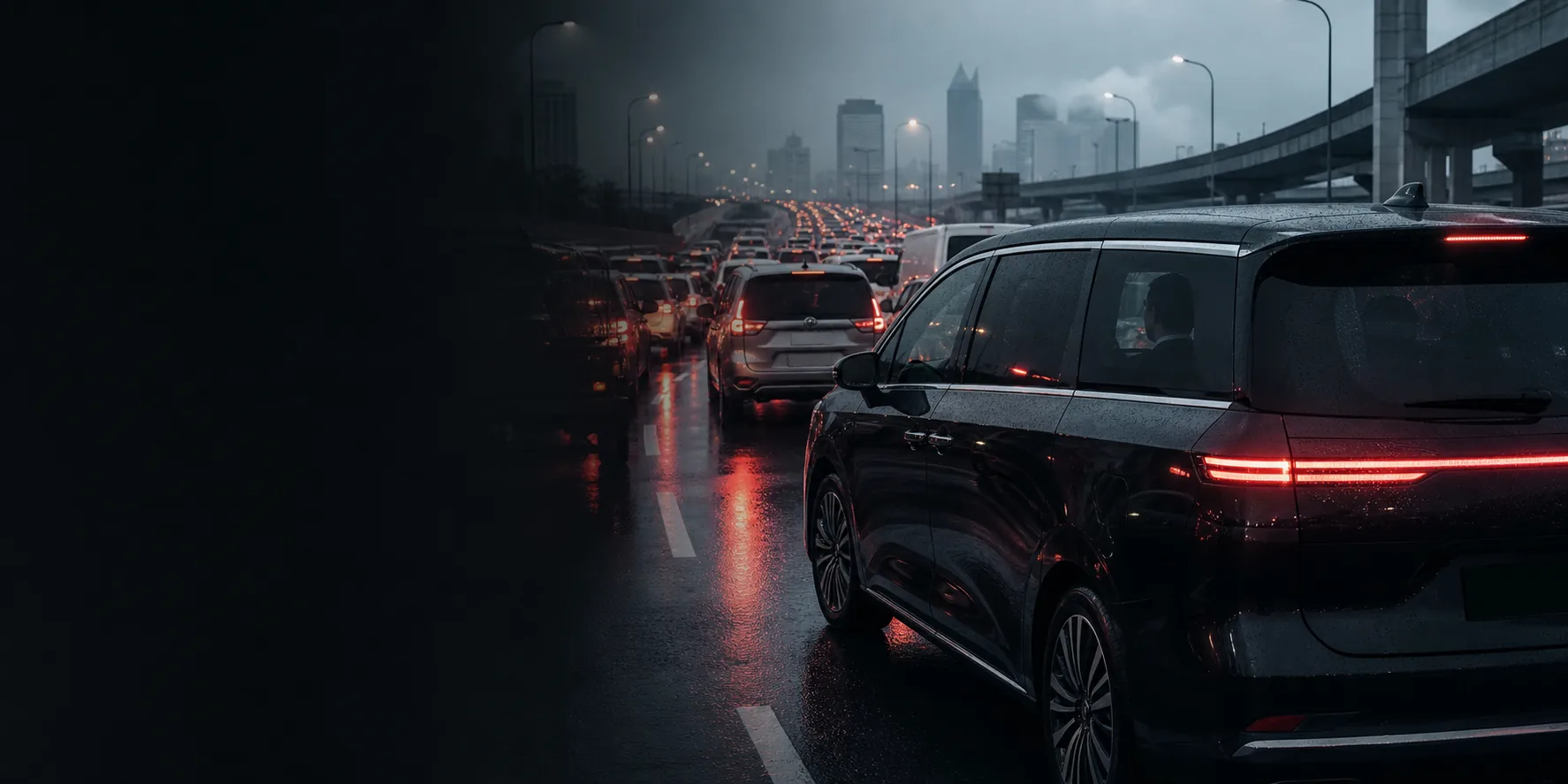
Tuesday · 7:45 AM · JORR toll road
An EV owner is crossing Jakarta on a day with no room for delay, and the battery buffer keeps shrinking as the schedule slips.
Traffic has stopped. The meeting keeps getting closer, the air conditioning keeps drawing power, and the range estimate gets harder to trust. Charging apps each point to a different station, but none of them answers the question that matters: can I get there, and will I still be on time?
The owner does the math. The EV might make it or not.
Next time, the gas car feels like the safer choice.
01 · The problem
The trust gap begins after adoption
Indonesia’s EV market accelerated rapidly in 2025. According to GAIKINDO, sales grew from 43,188 units in 2024 to 103,931 in 2025, roughly 2.4× year over year.[1]
Government incentives played a major role. VAT support[2] and traffic-policy exemptions[3] made EVs cheaper and easier to own. What they could not change is how an owner decides, each morning, whether the EV can handle the day ahead. That decision comes down to the battery percentage on the dashboard.
Battery percentage alone cannot account for traffic, weather, route changes, and charging availability.
Congestion can stretch a familiar trip, and changing weather and driving conditions make energy use harder to predict. Cabin cooling keeps drawing power throughout the delay.[7][8][9] If charging becomes necessary, availability and timing add another layer of uncertainty.[10] So even a trip the car can technically make becomes hard to plan with confidence. [6] When arrival time matters, drivers reach for the vehicle they trust to be predictable.
Incentives got people to buy EVs. Confidence is what makes them rely on one.
GAIKINDO wholesale BEV units, full year.[1]
Indonesia consumer signal
People already drive EVs daily; the hesitation is about range and charging
EVs are already part of everyday mobility here. The friction that remains shows up the moment range and charging time enter the plan.
PwC Indonesia eReadiness 2024. Owner and prospective-buyer cohorts are shown separately.[11]
02 · The diagnosis
Today’s EV tools still leave three gaps in the driver’s day
Across the research, the same three gaps keep coming up. The trip is hard to predict, a public charge is hard to count on, and not every owner can charge at home.
The prediction gap
An estimate made at departure assumes the road stays the same. Traffic, weather, driving style, and cabin cooling all change how much energy the trip actually takes.
The charging-confidence gap
A charger on the map still has to work when you arrive. Connector compatibility, app access, and whether a lot is free all decide whether the stop happens. Research calls this charge anxiety.
The charging-access gap
Home charging makes ownership easier, but access is uneven. In PwC’s Indonesia survey, 44% of prospective buyers called it a major purchase factor, yet not everyone has private parking.
Infrastructure is not the same as confidence
Indonesia permits private residential charging and reported 3,558 public charging units across 2,414 locations in March 2025.[4][5] Those figures establish growing supply. They do not show whether a particular owner has home access or whether a public charging stop will fit a fixed schedule.
Each gap is manageable on its own. Together they leave the driver guessing before a meeting they cannot be late for.
All of these gaps add up to one question.How might we assure confidence beyond sharing battery?
03 · Arrival Confidence
Designing for
Arrival Confidence
Arrival Confidence shows whether the driver can complete every planned trip on time and with enough battery. When confidence drops, it explains why and how to restore it.
The concept combines the driver’s plans with vehicle, traffic, weather, and charging data to see whether the day is still on track. It stays quiet while the plan holds and speaks up only when something important changes.
When a meeting is at risk, the product does not hand the driver another dashboard to read. It recommends one action and shows the consequence: arrival time, expected battery, and the confidence behind both.
One recommended action.
Show what changed, what to do, and how the day is protected.
Arrival Confidence does not promise perfect certainty. It makes changing conditions visible early, so drivers can decide with more warning. And every recommendation shows its trade-off, whether that is a warmer cabin, a short charge, or a slightly later arrival, so nothing important is hidden.
Cabin 18° → 24°C
- Arrive
- 09:52
- Battery
- 12–15%
Charge 12 min at Plaza Senayan
04 · The morning briefing
Setting confidence prior to the trip
Calendar planning
With permission, the service reads the time and location of travel-related calendar events, then combines them with vehicle, traffic, weather, and charging data to plan the day.
Morning briefing
Before the first trip, the driver sees whether the day is covered, the expected battery at each destination, the recommended charging window, and the confidence behind charger access.
Smart charging
Instead of waiting for a low-battery warning, the system looks for charging that fits the schedule the driver already has. It identifies chargers near a planned stop, such as lunch at Plaza Indonesia, and recommends the one that best supports the rest of the day. A two-hour lunch becomes a charging window instead of a separate errand.
Availability forecasting
The service combines live status with historical occupancy and reliability patterns to estimate whether a charger is likely to be usable at the planned time. It recommends one option, explains the confidence behind it, and warns the driver when access or queues remain uncertain.
Tuesday · Jakarta
Good morning, Andi.
Four meetings. One charge. Everything is covered.
Plaza Indonesia · Lot 3
Cabin warms before departure
JORR building · buffer holds
05 · Local calibration
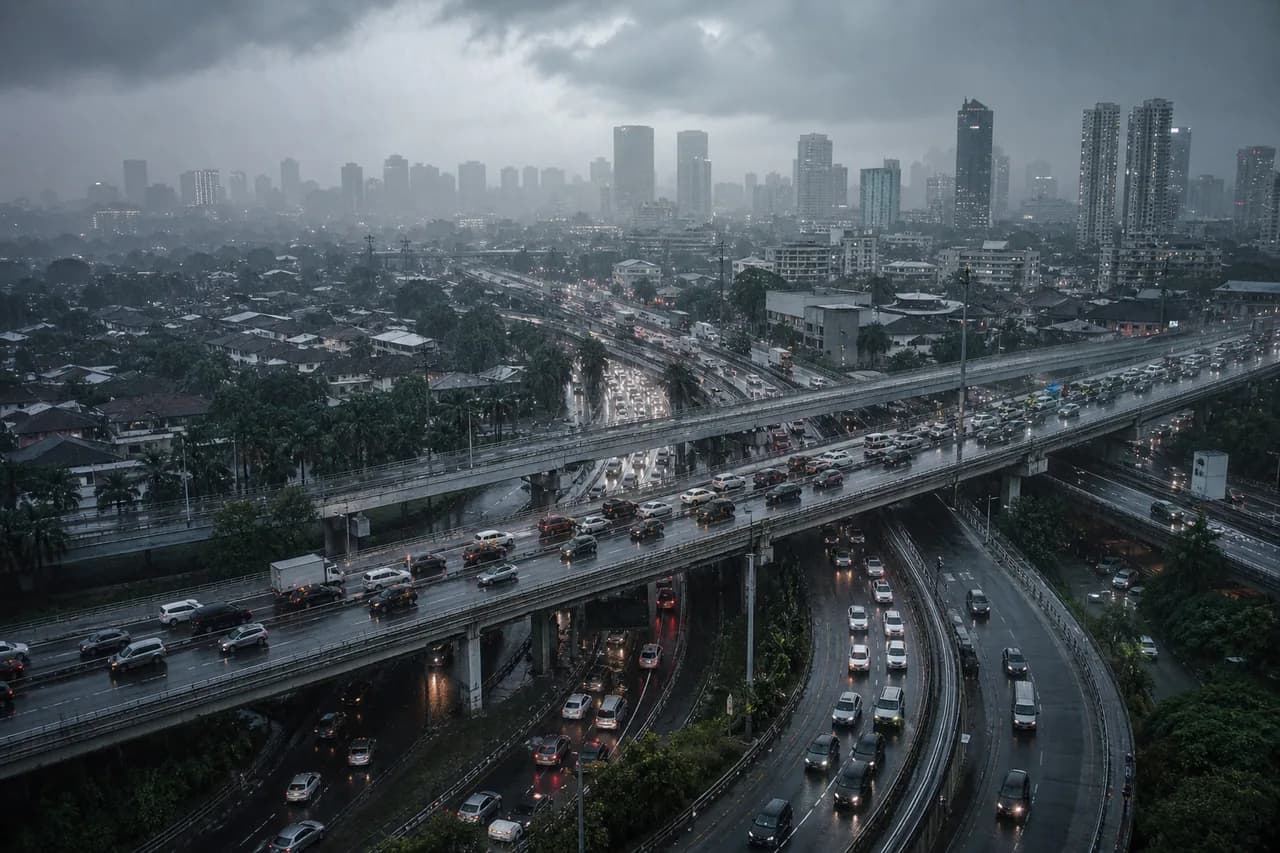
In Jakarta, the same route is rarely the same journey
A plan is only as good as the estimate behind it, and in Jakarta that estimate has to survive traffic and weather that change hour to hour.
What Jakarta actually varies
The route and the distance stay the same. Almost everything else about the journey moves, and each thing moves on its own schedule.
- Traffic — TomTom’s 2025 index puts an average 10 km Jakarta trip at 26 minutes 19 seconds, rising to 38 minutes 43 seconds in the evening peak at 15.5 km/h. [12] The distance is fixed at 10 km. The time in it is not.
- Rain — Your regular 30-minute commute can turn into a three-hour journey when rain hits Jakarta. Because wet roads slow each route differently, the delay and extra energy use are difficult to predict. [13]
- Heat — Jakarta is hot and humid all year, so the air conditioning is almost always running. It uses energy on top of what the car needs to move, and when a 26-minute trip stretches to 39 minutes, it runs almost 50% longer. [14]
- Road access — the odd-even plate rule covers 26 road segments on weekdays, 06:00 to 10:00 and 16:00 to 21:00. Electric cars are exempt, so at peak an EV can use corridors a petrol car cannot. [3]
A reliable estimate needs more than battery percentage
Past averages alone cannot reliably predict how much battery a trip will use. Traffic, weather, driving style, and air conditioning can all change from one journey to the next. In a Beijing study, adding just one live input, real-time traffic, made range estimates more accurate. [7]
Using current weather and the expected use of air conditioning gives a more accurate estimate of how far the car can travel. [14]
The system gets more accurate as it learns from real journeys
After each trip, it compares what it expected with what actually happened:
- planned and actual arrival time
- expected and actual battery on arrival
- assumed and actual route conditions
- planned and actual charging result, when charging was included
These comparisons help it adjust future estimates to the vehicle and driver. In one field test, average prediction error fell from 6.30% to 5.04%. Driver-specific models have also outperformed ten standard approaches using real-world data. [15][16]
What goes in
Ahead of the 10:00 meeting, with the cabin raised 18° → 24°C.
How might Jakarta’s traffic, weather, and uneven charging access help us test whether an EV can truly plan for the driver’s day?
06 · Feasibility
One simple recommendation depends on several systems working together
A single clear recommendation rests on several data sources lining up. Their coverage and reliability vary by vehicle, provider, and location, so the system also has to say when an input is missing or uncertain.
Day and vehicle context
The system needs the driver’s commitments, current battery, and vehicle-specific energy use.
Know what must stay on trackRoute and weather
Journey time, cabin cooling, rain, and known choke points must be translated into a locally calibrated energy estimate.
Model the operating conditionsCharging information
Connector compatibility, operational status, likely queues, and charging time must be combined to recommend a stop the driver can realistically use.
Recommend a workable stopAny service using real calendar or vehicle data would also need explicit consent, careful privacy controls, and clear disclosure when information is missing or uncertain.
07 · Back on the toll road
A day when the battery stops driving the plan
The moment an EV reads the road, weather, traffic, and plans ahead, the driver can stop thinking about energy and focus on the journey. That is the shift from managing a battery to trusting a car that understands the day.
The morning plan shows four commitments, one charging window, and no need for an extra stop.
Traffic begins to build on the JORR toll road.
The delay begins to reduce the arrival buffer. One recommended adjustment shows how to keep the next commitment on track.
The car charges during lunch, without adding another stop to the day.
The driver returns to BSD with the plan intact and energy decisions handled in the background.
The next important day arrives.
“I’ll take the EV.”
Evidence
Sources and boundaries
Market and policy statements use direct institutional sources. The opening scenario, product screens, confidence labels, and closing journey are illustrative and should not be read as measured product performance.
- GAIKINDO: Indonesian electric-car sales, 2022–2025
- Ministry of Finance: PMK No. 12/2025 EV tax support
- Jakarta Government: odd-even traffic policy and exemptions
- Ministry of Energy and Mineral Resources: private residential charging framework
- Ministry of Energy and Mineral Resources: March 2025 public charging count
- Barwick, Li, and Xia: Range Anxiety
- Scientific Reports: EV energy-consumption prediction with real-time traffic
- Scientific Reports: machine-learning prediction of EV energy consumption
- Nature: temperature and battery-electric vehicle performance
- Service Science: From Range Anxiety to Charge Anxiety
- PwC Indonesia: Electric Vehicle Readiness and Consumer Insights 2024
- TomTom: Jakarta Traffic Index 2025
- Sensors: weather-sensitive roads in Jakarta from smartphone sensor data
- SAE: climate-control power consumption in distance-to-empty estimation
- IEEE Transactions on Transportation Electrification: predicting EV energy consumption from field data
- Preference-aware meta-optimization for personalised vehicle energy estimation